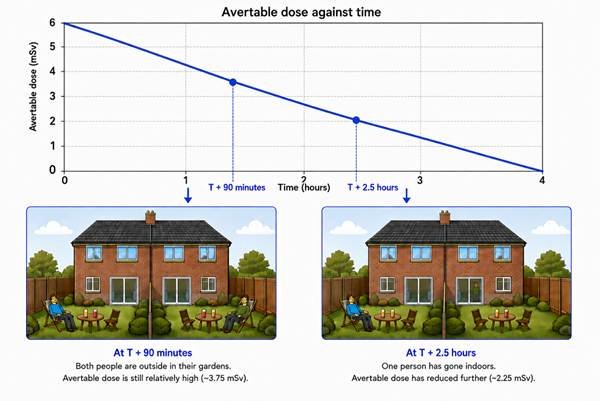
Imagine an event at a nuclear licensed site that is confidently expected to release radioactivity at a constant rate for four hours and then stop (if only we could rely on real events to be so clean).
Now imagine two semi-detached houses at a distance downwind that gives an inhalation dose rate of 3.75 mSv an hour for four hours. This translates to half an Emergency Reference Level of dose each hour. (The UK Lower ERL for shelter is 3 mSv dose averted which corresponds to 7.5 mSvv in the open).
As the plume arrives at their homes the projected doses to Mr Blue and Mr Green is 15 mSv comfortably above the action level of 7.5 mSv.
You would recommend that they shelter with some urgency. If they shelter from any time before T + 2 hours they would be assumed to avert more than 3 mSv. The sooner they shelter the better. For example, if Mr Green shelters from T + 1.5 hrs he would avert 3.75 mSv whereas if he sheltered immediately he would avert 6 mSv.
Now consider the situation at T + 2.5 hrs. You become aware that Mr Blue remains in his garden. The avertable dose is now 2.25 mSv. The system would not recommend him to shelter.
But the same system would not recommend that Mr Green break shelter – he is on to avert 3.75 mSv (above the ERL) if he remains in shelter but so far has only averted 1.5 mSv.
We recommend Mr Green stay in shelter but don’t recommend Mr Blue to shelter. Is that the right answer?