Imagine an event at a nuclear licensed site that is confidently expected to release radioactivity at a constant rate for four hours and then stop (if only we could rely on real events to be so clean).
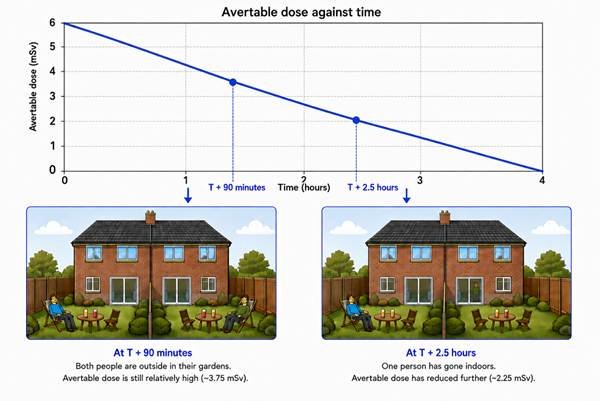
Now imagine two semi-detached houses at a distance downwind that gives an inhalation dose rate of 3.75 mSv an hour for four hours. This translates to half an Emergency Reference Level of dose each hour. (The UK Lower ERL for shelter is 3 mSv dose averted which corresponds to 7.5 mSvv in the open).
As the plume arrives at their homes the projected doses to Mr Blue and Mr Green is 15 mSv comfortably above the action level of 7.5 mSv.
You would recommend that they shelter with some urgency. If they shelter from any time before T + 2 hours they would be assumed to avert more than 3 mSv. The sooner they shelter the better. For example, if Mr Green shelters from T + 1.5 hrs he would avert 3.75 mSv whereas if he sheltered immediately he would avert 6 mSv.
Now consider the situation at T + 2.5 hrs. You become aware that Mr Blue remains in his garden. The avertable dose is now 2.25 mSv. The system would not recommend him to shelter.
But the same system would not recommend that Mr Green break shelter – he is on to avert 3.75 mSv (above the ERL) if he remains in shelter but so far has only averted 1.5 mSv.
We recommend Mr Green stay in shelter but don’t recommend Mr Blue to shelter. Is that the right answer?
It is common to assess the potential impact of a particular incident at a nuclear power station by estimating a source term for the event and then repeatedly running the source term through an atmospheric dispersion code with different weather conditions to provide a statistical distribution of off-site doses or other impacts.
Met data can be obtained from a variety of sources. These include local observations, nearby (or not so nearby) observations, or synthetic data obtained from the massive weather forecasting and recording models and databases. With improvements in the recording of weather data, synthetic data is increasingly seen as the better option.
Methodologies might run the dispersion code for each line of met data available or may sample the data to reduce computing costs/times but in the hope of the results remaining representative.
What this presentation fails to show is the outlying sequences, met sequences that might be expected to cause high doses further downwind than usual. These include sequences with very low mixing layers and sequences with very low wind speed (see table)
Sequence
Mix Layer/ m
Cat
Wind speed/ m/s
Rainfall
1802
16
F
0.41
0
1803
14
E
0.19
0
1804
17
E
0.49
0
2608
85
B
0.11
0
2698
457
B
0.45
0
2699
268
B
0.5
0
2700
312
B
0.17
0
3921
42
B
0.4
0.317
3951
129
B
0.35
0.05
4090
221
B
0.03
0
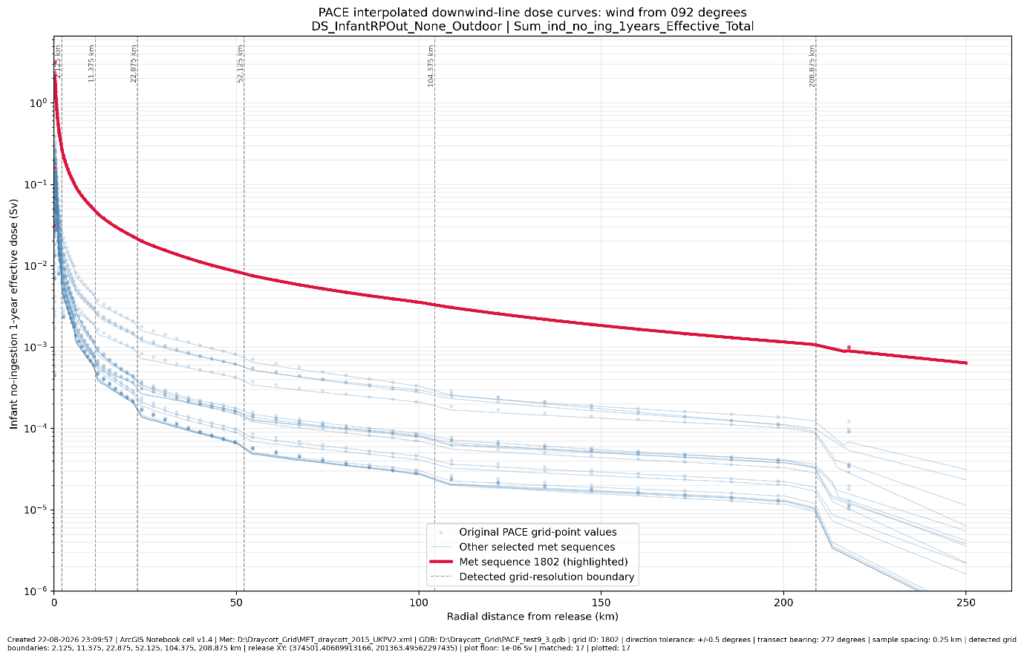
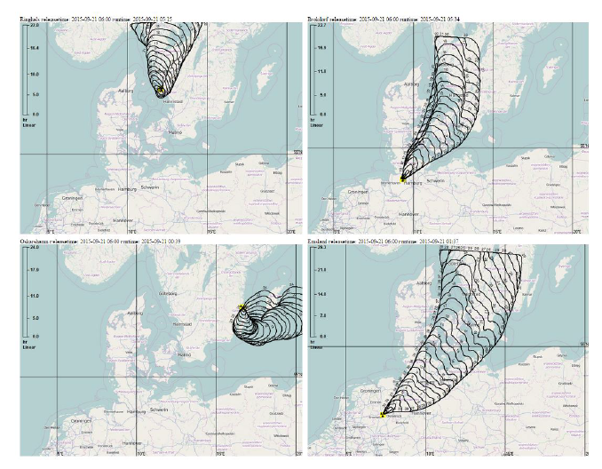
One of these (1802) is for a wind direction of 92 degrees. The figure below shows the dose as a function of downwind distance estimated using the ADEPT R-91 type dispersion code in the PACE model (https://www.ukhsa-protectionservices.org.uk/pace) calculated for all angle with a 92-degree wind direction with sequence 1802 highlighted.
This plot highlights a minor issue with the impact of a change in grid sizes and an issue with the linear interpolation I used to determine the dose at the downwind point of interest (PACE works on a grid rather than your chosen array of points). But it makes the point; there are weather conditions that may produce very different dispersion patterns.
This poses the question “should our emergency planning zones (assuming the source term is accepted as appropriate) be based on the average downwind distance for an exceedance, a high percentile (P95, P98, P100) of the downwind exceedance, or an exceedance by the average dose or a percentile dose at a particular distance”?
UK guidance is to use P95 which should eliminate these outliers (unless your random sample picks up too many of them).
Emergency planners should be aware that an accident could happen on a particularly cold night with very low wind speeds and, if it does, actionable radiation doses might extend much further than expected.
Of course, they might not. With these low wind speeds the penetration of the plume will be very sensitive to deposition (the assumption above is vg=1E-3 m/s) and to changes in the wind speed and direction. Not a good night to depend on your default arrangements or your dispersion code.
I listened to a presentation on the ARGOS (Accident Reporting Guidance and Operational Support – https://pdc-argos.com/index.html) decision support system today (25/08/26).
Their website tells us that ARGOS is useful throughout the entire disaster life cycle:
During the Preparedness phase for planning, dimensioning and training – including evaluation of various ‘What-if’ scenarios
During the Response phase by calculating prognoses about how the situation will evolve; what can be the consequences of the dispersion; what the proper emergency or evacuation zones are; etc.
During the Recovery phase; what will be the effect of applying possible countermeasures; etc.
In the Evaluation phase to study what could have been done better and how could the situation have evolved?
The code is based on the RIMPUFF atmospheric dispersion modelling code (https://inis.iaea.org/records/2mgb1-mfy59) but also has a model optimised for short urban distances (URD – useable for on-site doses, urban dirty bombs and chemical releases).
The code is available from PDC-Argos in Denmark.
Tracing back to 1986 (following Chornobyl) the code has been constantly maintained and updated, new features have been added.
It has customers through out the world.
Its role as a decision support system is to predict where a radioactive plume will go and estimate the projected doses and avertable doses given a possible suite of protective actions.
On the simple interface you pick a location, a source term and a start time from pull down menus (you can add your own site locations and source terms).
You can have up to 1000 release points all with their own source term and time structure.
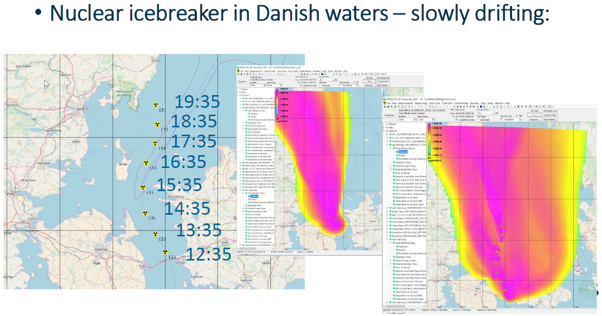
You can model moving sources (see below) which is novel but, with the trend to build floating SMRs and nuclear powered shipping, potentially useful.
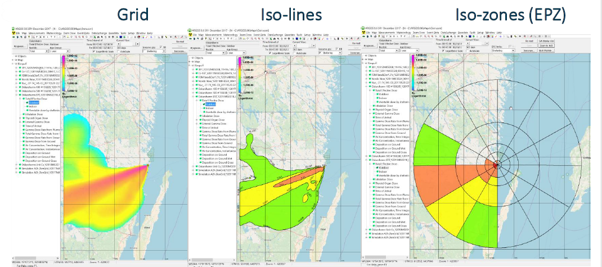
There are various output formats:
You can input data from permanent monitoring stations (including EurDep) , or manual measurements. It is not clear it me how these relate to the dispersion modelling but nonetheless it can be valuable to have measured data and predicted results in the same place.
It does food chain modelling, but to set up for a new region would be a significant amount of work. This allows you to predict where crops may exceed thresholds and for how long that situation would pertain.
You can investigate food countermeasures and land remediation.
You can investigate other dose pathways and how they might vary with time.
You can also now set it up to undertake continuous calculations – automatically work through a whole library of weather data and export to spreadsheet for a statistical analysis of the dose end points.
Automatic running also allows you to have periodic (daily or hourly maybe) predictions of plume arrival times for different source locations.
This seems like a good code to have available in national response centres linked to the national meteorological centre and the national fixed monitor grid, preloaded with NPP locations and a library of sources terms from the safety cases of each. You would then need a skilled operator or two to update the data being fed into the model and interpreting the results and decision makers familiar with the output and the radiological implications of an airborne plume.
The initial role would be radionuclide plume footprint and arrival times (where to apply protective actions), followed by avertable dose as a function of time – checking protective action advice to confirm that it is of sufficient initial extent and is withdrawn in a timely manner.
If you use the code in the planning stage to determine how big the emergency planning zones should be under different circumstances you would gain valuable experience in setting up the code and running it.
It can also be used in exercises, generating off-site radiological conditions for the umpire’s side and modelling the release footprint, arrival time and dose implications for the players.
A useful code for a national response body and a nuclear utility to consider.
This article has been largely written by AI during a conversation lasting about an hour. It seems to me to make sense and the conclusions appear sound. But it for you, the reader, to judge.
1 Purpose
This article describes the basis for the estimates used for the proportion of four population groups — baby/pre-school child, school-age child, adult and elderly person — who would, at different times of day, either already be within a building or be able to reach a substantial building within a specified period.
The estimates were developed for emergency-planning purposes, particularly circumstances in which rapid sheltering may be advised following an atmospheric release. They are derived planning estimates rather than directly observed population statistics. No UK dataset has been identified that directly records the proportion of the population that is, at a particular time, within 5 or 15 minutes of a suitable building.
The estimates therefore combine evidence on:
time spent at home and undertaking different activities;
travel and walking;
age-dependent travel behaviour;
children’s outdoor activity;
outdoor occupations; and
the accessibility of open and green spaces.
The resulting estimates are reproduced in Table 1.
Table 1. Estimated population location relative to accessible substantial buildings
Age group
Period
Already inside
Outside but shelter ≤5 min
Shelter 5–15 min
>15 min from shelter
Shelter ≤15 min
Baby/pre-school
Night
99%
0.5%
0.3%
0.2%
99.8%
Working day
94%
4%
1.5%
0.5%
99.5%
Evening
96%
2.5%
1.0%
0.5%
99.5%
Weekend day
92%
5%
2%
1%
99%
Child
Night
99%
0.5%
0.3%
0.2%
99.8%
School day
94%
4%
1.5%
0.5%
99.5%
Evening
91%
5%
2.5%
1.5%
98.5%
Weekend day
85%
8%
4%
3%
97%
Adult
Night
98%
1%
0.5%
0.5%
99.5%
Working day
86%
7%
4%
3%
97%
Evening
90%
5%
3%
2%
98%
Weekend day
84%
8%
5%
3%
97%
Elderly (65+)
Night
99%
0.5%
0.3%
0.2%
99.8%
Weekday day
93%
4%
2%
1%
99%
Evening
96%
2%
1.5%
0.5%
99.5%
Weekend day
91%
5%
2.5%
1.5%
98.5%
Percentages have been rounded and should not be interpreted as having the statistical precision implied by the individual values.
2 Definition of the location categories
For this assessment a substantial building means a normally occupied or occupiable enclosed building that could provide materially greater protection from an airborne release than remaining outdoors. Houses, schools, offices, shops, public buildings and substantial industrial or commercial premises would normally qualify. Open shelters, lightweight open-sided structures and vehicles have not been assumed to be equivalent to substantial buildings.
Four states were considered:
Already inside: the person is already within a substantial building.
Shelter within 5 minutes: the person is outside but is in a location from which a substantial building could reasonably be entered within approximately five minutes.
Shelter within 5–15 minutes: access is possible but is not immediate.
More than 15 minutes from shelter: the person is in a location or undertaking an activity for which access to a substantial building within approximately 15 minutes cannot reasonably be assumed.
The assessment is consequently not an estimate simply of the fraction of people who are outdoors. This distinction is important. A person walking along an urban street, standing in a school playground or working outside a commercial building is outdoors but may be only seconds or minutes from a substantial building. Such a person is materially different, for emergency-planning purposes, from a hill walker, agricultural worker in a remote field or person on an isolated beach.
3 Adult time-use evidence
The principal evidence concerning the distribution of adult activity through the day was the ONS Time use in the UK: 23 September to 1 October 2023 survey. Participants recorded their activities over complete 24-hour periods. Each participant was allocated one weekday and one weekend diary day. Main activities were recorded in 10-minute periods. The survey therefore provides a useful empirical basis for distinguishing weekday and weekend behaviour and the major components of the day, including sleep/rest, work, household activity, leisure and travel.
The survey does not, however, provide a direct measure of distance or travel time to a suitable building. Time-use evidence was therefore used primarily to constrain the fraction likely to be at home, at work or undertaking other activities, rather than to determine the 5- and 15-minute categories directly.
The very high night-time indoor fractions in Table X.1 follow principally from the dominance of sleep/rest and residential activity during the night. A small residual outdoor fraction was retained to represent night workers, travellers, social/leisure activity and other exceptional circumstances.
Adults were assigned the lowest daytime indoor fraction because this group contains most commuters, outdoor workers and people undertaking travel, shopping, recreation and other activities away from home.
4 Travel
Travel represents one of the principal reasons why a person may not be inside a building at a randomly selected time. The Department for Transport National Travel Survey 2024 (NTS) was therefore used as a second principal evidence source.
The NTS shows substantial travel activity across the population and permits differentiation by age, journey purpose and mode. It was used to constrain the amount of time that could plausibly be assigned to the outdoor and travelling categories.
Travel was not treated as synonymous with inability to shelter. This is an important methodological assumption.
Much travel takes place within built-up areas or between buildings. Similarly, a walking trip does not imply that the pedestrian is remote from shelter. A person walking through a town centre may be outside for an appreciable period while remaining continuously within a minute or two of shops, offices and other buildings.
Consequently, only a fraction of travel activity was allocated to the 5–15-minute category and a still smaller fraction to the >15-minute category. This is a judgement-based allocation rather than an NTS statistic.
5 Children
The principal additional source used for children was the ONS analysis Children’s engagement with the outdoors and sports activities, UK: 2014 to 2015, derived from UK time-use data.
Children aged 8–15 spent an average of 16 minutes per day in parks, countryside, seaside, beach or coastal locations. The corresponding daily participation rate was 12.2%. ONS also found higher average time in these locations at weekends than during weekdays, although the reported difference was not statistically significant.
This evidence was particularly useful because it prevents all children’s leisure or sporting activity from being classified as genuinely remote outdoor activity. Sports and active leisure include activities undertaken indoors and activities undertaken immediately adjacent to buildings.
The child estimates were therefore constructed on the following basis:
night-time occupancy was assumed to be overwhelmingly residential;
school-day occupancy was assumed to be dominated by home and school, both providing immediate building access;
the outdoor fraction was increased during evenings; and
the largest outdoor and remote fraction was assigned to weekend daytime, reflecting greater opportunity for outdoor recreation, sport and countryside activity.
This produced an estimated 3% >15 minutes from a substantial building during weekend daytime, compared with approximately 0.5% during the school day.
The distinction is deliberately conservative because even participation in a park, countryside or coastal activity does not demonstrate that the participant is more than 15 minutes from a building.
6 Babies and pre-school children
There is less direct activity-location evidence for babies and very young children. Their estimates therefore have greater inferential content.
The principal assumption was that babies and pre-school children spend a greater proportion of their time either at home or in childcare, nursery, retail, hospitality or other locations containing buildings. They are also normally accompanied when travelling or undertaking outdoor activity.
A smaller genuinely remote fraction than for school-age children was consequently assigned.
Weekend daytime was again assigned the largest outdoor component, giving an estimated 1% >15 minutes from a building. The estimate is intended to encompass family countryside recreation, beaches, parks and other activities away from buildings.
No claim is made that the 1% value has been directly measured.
7 Elderly population
Older people were assigned high building-accessibility fractions because employment and commuting become progressively less important with age and a greater proportion of activity is residential.
The NTS age breakdown was used qualitatively in making this judgement because it demonstrates substantial changes in journey purpose and mode with age. It also prevents the erroneous assumption that elderly people are almost continuously at home: shopping, personal business, social activity and recreational walking remain important activities amongst older groups.
Accordingly, the estimates allow an appreciable daytime outdoor/travelling fraction while retaining a comparatively small >15-minute fraction. The estimated latter fraction ranges from approximately 0.2% at night to 1–1.5% during daytime/weekend periods.
8 Outdoor occupations
Outdoor employment was specifically considered because it could otherwise result in an underestimate of the adult weekday exposed population.
HSE identifies occupations involving significant outdoor exposure including farm workers, construction workers, market gardeners, outdoor-activity workers and some public-service workers.
ONS also provides Annual Population Survey employment estimates at four-digit occupational classification and four-digit industry level, including breakdowns by age and country. This confirms that sufficiently detailed employment data exist to identify occupational groups with a significant outdoor component.
Outdoor employment was nevertheless not equated with remoteness from buildings. Conceptually, the contribution from an occupation was considered as:
occupational prevalence × fraction of working time outdoors × fraction of outdoor working time remote from a suitable building.
For example, agricultural and forestry work can place workers appreciable distances from buildings and was therefore regarded as contributing disproportionately to the >15-minute category.
Construction workers may also spend a substantial fraction of their working day outdoors, but construction sites frequently contain completed or partly completed buildings, site offices, welfare accommodation and adjacent development. Their probability of being outdoors is therefore substantially greater than their probability of being more than 15 minutes from any usable building.
This distinction was one reason why a relatively large outdoor component could coexist with the comparatively small 3% adult weekday >15-minute estimate.
9 Open-space accessibility
A further plausibility check was provided by Defra’s 2026 Access to green and blue space in England statistics.
Defra defines its “15-minute commitment” in terms of access by walking route to specified green/blue spaces. It reports that 80% of households in England have access to at least one qualifying green or blue space within a 15-minute walk, increasing to 91% for rural households and decreasing to 78% for urban households.
These statistics cannot simply be inverted to calculate distance from a building. They nevertheless provide a useful spatial plausibility check.
In particular, they demonstrate that a large amount of access to parks, paths and other outdoor space occurs directly from the built environment. Consequently, categorising everyone engaged in outdoor recreation as being remote from buildings would substantially overstate the population unable to shelter rapidly.
The Defra evidence was therefore used qualitatively to constrain, rather than directly calculate, the >15-minute fractions.
10 Construction of the estimates
The entries in Table 1 were produced sequentially.
First, a central estimate was made of the fraction already within buildings, using the time-of-day activity pattern appropriate to each age group.
Second, the residual outdoor/travelling population was divided between locations expected to have immediate building accessibility and locations involving progressively greater separation from buildings.
Third, NTS travel evidence was used to check that the outdoor/travelling fraction was compatible with observed levels of travel.
Fourth, the child estimates were checked against the ONS outdoor-activity evidence.
Fifth, the adult weekday estimate was increased relative to the other groups to accommodate outdoor occupations and work-related travel.
Sixth, the weekend child and adult fractions were increased to represent outdoor recreation.
Finally, the estimates were checked against the Defra spatial-access evidence to ensure that outdoor recreation had not implicitly been treated as synonymous with remoteness from buildings.
The method is therefore best described as a constrained expert-judgement model rather than a statistical derivation.
11 Uncertainty and conservatism
There are two different types of uncertainty in Table 1.
The first concerns the fraction already inside a building. This is reasonably well constrained by time-use, employment and travel evidence, although there remains uncertainty concerning the precise definition of indoor activity.
The second, and substantially larger, uncertainty concerns the division of the outdoor population between the ≤5-minute, 5–15-minute and >15-minute categories. No identified national survey measures these quantities directly.
Consequently, values such as:
Adult, working day: 86% inside, 7% within 5 minutes, 4% within 5–15 minutes and 3% beyond 15 minutes
should not be interpreted as measurements with percentage-point precision. A more appropriate interpretation is that the evidence indicates an indoor fraction of approximately 85–90%, while expert judgement suggests that most of the residual population remains close to buildings and only a few percent is likely to be genuinely remote.
For this reason, where the purpose is emergency-planning modelling rather than demographic analysis, a simpler assumption is preferable.
The detailed analysis indicates central estimates of approximately 97–99+% of the population able to obtain access to a substantial building within 15 minutes, depending upon age and time of day.
A generic assumption of:
95% able to obtain substantial shelter within 15 minutes
was therefore proposed as a deliberately conservative planning value.
This 95% value is not an ONS, DfT, HSE or Defra statistic. It is a modelling assumption derived from the evidence described above and incorporates an allowance for uncertainty.
12 Limitations
The estimates are intended to characterise a generic UK population. They should not automatically be applied to a particular site without considering local circumstances.
The proportion unable to reach shelter rapidly could be higher around locations characterised by extensive:
agricultural land;
moorland or mountains;
beaches and coastline;
large parks or recreational areas;
forestry;
reservoirs and other water-based recreation;
outdoor industrial activity; or
transport infrastructure remote from occupied buildings.
Conversely, the generic estimates are likely to be conservative in densely developed urban areas where people outdoors are generally close to multiple buildings.
The analysis also considers physical access to a building, rather than whether the building is open to the public, whether access would be permitted during an emergency, or the degree of radiological protection actually afforded by the building. These issues would require separate consideration.
13 References
Office for National Statistics (2023).Time use in the UK: 23 September to 1 October 2023. Experimental statistics. The survey used full 24-hour diaries, with participants allocated one weekday and one weekend diary day. ONS — Time use in the UK
Office for National Statistics.Children’s engagement with the outdoors and sports activities, UK: 2014 to 2015. Includes time and participation rates for children aged 8–15 in parks, countryside and coastal locations. ONS — Children’s engagement with the outdoors and sports activities
Department for Transport (2025).National Travel Survey 2024. Used for travel frequency, duration, purpose, mode and age-dependent travel behaviour.
Health and Safety Executive.Outdoor workers and sun exposure. Identifies occupational groups for whom work involves extended periods outdoors, including agricultural and construction workers. HSE — Outdoor workers and sun exposure
Office for National Statistics (2026).Employment by detailed occupation and industry, by sex, age group and country, 2024 and 2025. Annual Population Survey estimates at four-digit occupational and industry classification. ONS — Employment by detailed occupation and industry
Department for Environment, Food & Rural Affairs (2026).Access to green and blue space in England. Official statistics in development; provides walking-route-based measures of access to qualifying open spaces, including the 15-minute commitment. Defra — Access to green and blue space in England
Overall evidential status
The source evidence supports the proposition that most people are either indoors or undertaking activities in locations from which buildings are readily accessible. It does not directly measure building accessibility.
Accordingly, Table 1 should be described as derived planning estimates informed by UK time-use, travel, employment and spatial-access statistics, rather than as measured population fractions. The greatest uncertainty attaches to the allocation of people who are outdoors between the ≤5-minute, 5–15-minute and >15-minute categories.
I think that this NEA report provides a useful contribution to the protective actions discussion and should be widely read within the industry, relevant local authorities, government bodies and regulators.
To whet their appetite they could start with my review.
The NEA Small Modular Reactor (SMR) Dashboard offers a comprehensive assessment of global progress in SMR development, focusing on seven key dimensions: technical readiness, licensing, siting, financing, supply chain, engagement, and fuel.
The second edition of the Dashboard evaluates 56 SMR designs worldwide, highlighting significant advancements toward deployment and commercialization in both NEA and non-NEA member countries.
SMRs are characterized by their smaller size, typically producing up to 300 MWe, with some designs as small as 1-10 MWe. They are designed for modular manufacturing, factory production, portability, and scalability, offering potential benefits in safety, operational flexibility, economics, and waste management.
The Dashboard reveals substantial progress in SMR deployment, with a subset of designs in advanced stages of commercialization. The first SMRs are expected to be operational within this decade, with accelerated global deployment anticipated in the 2030s.
The report also shows what a crowded market the SMR world has become.
ONR’s new document Safety Culture: Definition and Model (2024)[1] “introduces the Office for Nuclear Regulation’s (ONR) definition and model of safety culture. Its purpose is to create a collective understanding of safety culture across Great Britain’s nuclear industry to improve organisational learning, and to provide ONR with a simple and straightforward way to engage with those that we regulate on this important topic”.
Safety culture has been defined as that assembly of characteristics and attitudes in organizations and individuals which establishes that, as an overriding priority, nuclear plant safety issues receive the attention warranted by their significance (INSAG-4, 1994).
The NISCI is a research-driven tool[2] that evaluates safety culture across nuclear organisations. Its foundation lies in the IAEA’s Harmonised Safety Culture Model, adapted to the specific needs of Great Britain’s nuclear sector through input from all UK licensees. It focuses on identifying and improving underlying attitudes, behaviours, and values related to safety.
It presents a theoretical model based on the work of Schein (1985) and others which has 6 dimensions and 16 sub-dimensions. “The model differentiates between the underlying foundations of culture, in terms of policies, processes, training, and communications, which organisations have in place to support the safety culture, and the elements of the culture which reflect the underlying values, beliefs, and attitudes towards safety”.
The 6 dimensions are:
Reporting – Focused on fostering a sense of safety, confidence, and informed compliance.
Senior Leadership – Encompassing communication, consistency, and openness about safety.
Line Management – Addressing communication, consistency, and receptiveness at the managerial level.
Challenge – Encouraging a questioning attitude and attentiveness to weak signals.
Accountability – Promoting a “just culture” where accountability is constructive.
Immersion – Relating to employees feeling valued and engaged in safety efforts.
For each of the 6 dimensions the ONR provides a few “attributes” (or “sub-dimensions) that it looks for and the summary of what bad and what good looks like.
In this the mechanism is rather like the IAEA 2020 Working Document “A Harmonized Safety Culture Model”.[3]This gives us a definition of ‘safety’ is “the protection of people and the environment against radiation risks, and the safety of facilities and activities that give rise to radiation risks” (which seems excessively focussed on radiation whereas, I suspect, more people are hurt by slips, trips and falls).
The research paper reports the results of a consultation involving 3,480 workers from 15 nuclear duty holders. It concludes that the scores are high, reflecting the high standard of safety in the GB’s nuclear industry.
ONR highlights the importance of continuous improvement in these areas, advocating for clear communication, consistent leadership actions, and worker engagement to strengthen safety performance and outcomes.
I expect we will see this take life as a periodic questionnaire distribution and comparison of results from site to site and from time to time. But a strong safety culture isn’t just about compliance—it’s about fostering a proactive environment where safety is part of every decision. Tools like NISCI help organisations benchmark their performance, identify gaps, and create tailored improvement plans. This is particularly valuable in building public trust and ensuring operational excellence.
See also
NRC 2004 Principles for a Strong Nuclear Safety Culture
Principles for a Strong Nuclear Safety Culture Addendum I: Behaviors and Actions That Support a Strong Nuclear Safety Culture
WANO PRINCIPLES Traits of a Healthy Nuclear Safety Culture May 2013
I listened to a very interesting talk organised by the Emergency Planning Society, a Lunchtime Learning Session – Plymouth Unexploded Ordinance Device Incident.
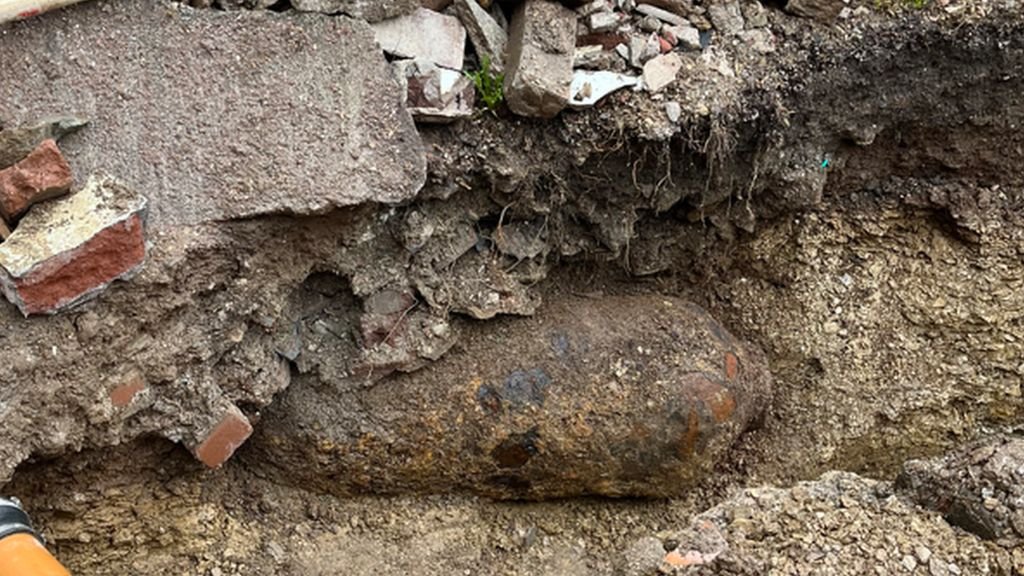
A 500 kg unexploded bomb from an air raid between 28th and 29th April 1941 was found when digging out the foundations for a house extension.
The on-call emergency responder took the initial call just before 11 am and at 13.30 the Police declared a Major Incident. An initial 214 m evacuation cordon was put in place with the National mobile phone warning system used in anger for the first time and teams from multiple organisations going door to door. The zone evolved with time.
More than 4,200 properties were evacuated involving more than 10,300 people. While many made their own arrangements more than 1000 attended Rest Centres over the three days and more than 1000 calls were received on the 24/7 helpline and 73,000 hits on the website.
The bomb was later moved and destroyed at sea. The move entailed a temporary evacuation of the area either side of the route.
Of particular interest:
A few people were reluctant to leave their homes. Major concerns seemed to be about pets (RSPCA helped) although there were some health issues to manage. These all take resources to work through.
There is a reluctance to use gyms for overnight stays. Preference is to put people up in B&Bs or hotels.
The National Emergency Notifier System worked well with the message out within 30 minutes of the decision to use it. With prepared messages this could be speeded up. Unsurprisingly the system “leaks” in that the message is received beyond the intended footprint so it is important to consider the wording of the message – not “please evacuate” but “please evacuate if you are in this area”.
The council rejigged their “when are my bins emptied” website to show the intended evacuation area in detail. Which was a quick process. Well done Council GIS team.
The area followed the REPPIR process of zigzagging along streets rather than cutting through lines of houses. Good practice.
The local football ground was used as a briefing centre for the boots on the ground.
Supply of sand was successful but not needed in the end (If bomb had been detonated in-situ it would have been surrounded by sand to manage the explosion).
Vulnerable people were identified by door knockers rather than by comparison of agency lists. This was not what the plan expected.
A very interesting talk about the day in a life of a council emergency responder and a good example of multiple agencies working together well. The response would probably not have been so successful without the careful planning and exercising that takes place.
Sheltering in place is thought to be an effective protective action in the case of releases of radioactive dusts and gases from nuclear sites because it reduces gamma radiation dose by a combination of shielding and distance and it reduces the inhalation dose while the airborne levels are higher outside than in. If you are going to stay in shelter for any length of time with elevated external levels it is obviously better to reduce air exchange between the inside and outside.
The UK national advice on the topic has “Key factors affecting the effectiveness of sheltering-in-place include: the air permeability of a building used for shelter; the meteorological conditions; the particle size distribution; the effectiveness/timing of opening windows and doors; and the release duration, all of which could vary significantly from one scenario to another (or even within a single scenario). Some of these factors such as meteorological conditions are time dependent, and therefore the DRF may vary as a function of time.” (PHE-CRCE-049)
Advice to the public in the UK is provided by REPPIR Prior Information leaflets and websites for those near to nuclear sites. These tend to have the advice to close doors and windows and will then say something about other steps that can be taken to reduce air exchange. Examples: Barrow: “Switch off fans, heating systems, air conditioning and put out open fires”. Capenhurst: “Switch off all heating systems. Ventilation fans and air conditioning systems to avoid drawing in outside air”. Devonport: “Put out fires and boilers and shut off air conditioning units. Fans, air conditioning units, boilers, gas fires and heating systems draw in air from outside. You should switch off these things (and damp down open fires) to stop radioactive material from outside coming inside”. EDF sites “close all outside doors and windows, switch off any ventilation or extractor fans”. [No mention of heating!] AWE “Turn off boilers and air conditioning units and put out fires or woodburners. Fans, heating systems, boilers, gas fires and air conditioning all draw in air from outside so these should be shut down to minimise radioactive particles entering buildings”.
While the physics suggests that air exchange between the outside world and the inside of a building is affected by the temperature difference most of the historic concern, I suspect, is with systems that burn hydrocarbons in-situ and are designed to draw in air to support combustion. Not everybody uses such systems these days.
Are there forms of heating that we can use safely while in shelter – electric panel convection heaters or air source heat pump serving underfloor or ceiling mounted fan coil units that don’t obviously rely on external fresh air or do we all have to freeze while waiting for the all-clear or evacuation instructions?
This article is a brief synopsis of an NHS England paper looking at how it relates to nuclear licensed sites. Please refer to the original paper rather than this article if preparing plans. Katmal Limited can provide advice on planning should you require it.
“Members of the public who may be contaminated, especially following large incidents, may leave the scene and subsequently seek assistance at a nearby healthcare facility. All healthcare facilities are required to have arrangements in place to manage self-presenting patients. These plans need to recognise that people concerned about the health impacts of a HazMat/CBRNE contamination incident, but not necessarily affected by it, may also attend healthcare facilities and other NHS sites even though they do not require treatment.”
Timely alerting – are all NHS facilities alerted to a local incident?
Planning risk assessment
“The risk assessment should also take account of the need to protect healthcare facilities, staff members and uncontaminated patients and the provision of timely and appropriate care to people self-presenting from a HazMat/CBRNE incident”. This risk assessment is likely to conclude that anyone self-presenting following an accident at a nuclear reactor site may be contaminated with fission products (other licensed sites have their own specific hazards – for example plutonium, uranium or tritium for AWE) but, actually this remains unlikely and the levels of contamination if they were to be contaminated would not be sufficient to affect the health of staff members, uncontaminated patients or other persons on site. What remains is a presentational issue. How do we assess and reassure the self-presenter and how do we maintain confidence that the facility is fit for purpose against rumour that it is badly contaminated?
The paper does not mention it but for those NHS facilities near a licensed site it would be sensible to understand the type of contamination that is possible and how it could be identified and measured on people. This is easier for sites that might release beta/gamma active materials rather than sites that might release pure alpha emitters. But either way, an understanding of how to detect and measure plausible local contaminants should be pursued and suitable instruments maintained.
“Organisations may wish to identify areas of their premises where IOR [Initial Operational Response] activities can take place. This would include access to clean running water and be considerate of patient modesty. Such areas could be marked with zones for patients to disrobe and then move to, making communication easier”.
Ideally the facility would be able to move the self-presenters to a remote area where they can be processed without the potential to contaminate busy areas of the facility. Initial screening might be by questioning where the person was and what they were doing during plume transit.
“An incident of this nature has the potential to be disruptive and may result in the affected premises being compromised for a period of time. The plan will need to link to the organisation’s business continuity arrangements to mitigate this.”
Section 3.6 of the paper reviews the potential psycho-social impacts of the event stating that the public are likely to be orderly, will respond better in a well planned and executed response with clear information, efficient, polite and caring handling of self-presenters including respected the need for privacy and modesty during decontamination. It is important to plan and train to get this aspect of the response right.
“Available evidence suggests public behaviour will be orderly and there will be no panic.”
“These arrangements and the Remove, Remove, Remove model do not require staff members to wear specialist protective equipment[1] nor does it require specialist decontamination equipment for the patient to use. Instead the model utilises any absorbent material such as blue roll or paper towels which can be retrieved from most building’s toilets or kitchen facilities”.
Lock-down procedures might be required to control access and egress to the facility to minimise confusion and the spread of contamination. “It should be noted, however, that healthcare organisations cannot physically prevent people from leaving their premises (even if the hazard or threat is outside the building which is locked down)”.
The NHS has a STEPS 1-2-3 protocol:
“The Emergency Services use the STEPS 1-2-3 plus process as a recognition and risk assessment tool. If one incapacitated patient is encountered with unexplained symptoms then they are treated using NHS universal precautions. If two incapacitated patients are encountered together with unexplained symptoms they are treated with caution and a high index of suspicion of contamination using NHS universal precautions. When three or more incapacitated patients are encountered together with unexplained symptoms the staff withdraw to a safe distance and call for specialist resources and advice. At the same time the plus element indicates the instigation of IOR.”
This is very unlikely to be triggered for a nuclear accident at a licensed site as the dose rates are likely to be too low to trigger symptoms. It could be triggered if a powerful source is left in a public space (See Cochabamba bus incident 2002) or if a powerful source is dismantled and distributed among a population (See Goiania orphan source incident 1985).
The remove, remove, remove Initial Operational Response then comes into play.
Tell those affected to:
Remove themselves … from the immediate area to avoid exposing others. Fresh air is important.
Remove outer clothing …
Avoiding pulling clothes over head if possible;
Do not eat, drink or smoke
Do not pull off clothing stuck to skin
Remove the substance …. from the skin using a dry absorbent material to either soak up or brush it off.
Again, it is unlikely that skin will be itchy or painful as a result of radioactive contamination. Care should be taken not to break the skin and allow contaminants a route into the body.
Under the remove themselves banner it is suggested that the self-presenters should be isolated from other patients and staff members in a safe area, preferably outside. Continuous clear communication would be key so that the worried person does not feel abandoned.
The advice for removing outer clothing (which is expected to remove most of the contamination) suggests that “Undressing should be systematic to avoid transferring any contamination from clothing to the skin”. It recommends cutting clothes off rather than pulling them over the head. The important thing is to avoid touching the outer surface, particularly avoiding the outer surface coming into contact with the mouth, nose or eyes.
Modesty and warmth may become an issue when asking members of the public to disrobe outside.
Removed clothing should be bagged and labelled but this process should not be allowed to slow the undressing process unduly.
Dry decontamination, blotting and lightly rubbing skin with any dry absorbent material such as paper tissue, clean cloth etc is the preferred for of decontamination.
Hair may need careful wet decontamination. In the meantime potentially contaminated hair should be covered and away from the face.
If there is an incident a dynamic risk assessment would be expected from those in charge.
“When conducting a dynamic risk assessment there are five principal stages to be followed:
Stage 1 – Identify the hazard
The first step is to look for hazards. Consider the location that the activity or process is carried out and check for potential dangers. Concentrate on anything with the potential to cause serious harm to employees, members of the public and the patient(s).
Stage 2 – Decide who might be harmed and how
Decide who and how many might be at risk
Stage 3 – Evaluate the risks and identify suitable and sufficient control measures
Implement the Remove Remove Remove procedures
Stage 4 – Record and implement findings
The findings of the risk assessment must be brought to the attention of those at risk to harm and appropriate training and instruction given on the implementation of the control measures.
Decide who and how many may be at risk; is it those undertaking the activity or may it also affect members of the public and staff.
Stage 5 – Review the assessment
All risk assessments should be reviewed at a frequency proportional to the risk.”
Section 5 states that there might ne a requirement to seek specialist advice. This may come from UKHSA or the operator of the facility that is the source of the issue.
There is more discussion about PPE (Section 6) and Quarantine (Section 7) and a larger section on Recovery (Section 8).
This is a refreshingly short and focused advice sheet with sensible sounding advice.
[1] Direct physical contact with the patient(s) should be avoided.