Outlying weather conditions

It is common to assess the potential impact of a particular incident at a nuclear power station by estimating a source term for the event and then repeatedly running the source term through an atmospheric dispersion code with different weather conditions to provide a statistical distribution of off-site doses or other impacts.

Met data can be obtained from a variety of sources. These include local observations, nearby (or not so nearby) observations, or synthetic data obtained from the massive weather forecasting and recording models and databases. With improvements in the recording of weather data, synthetic data is increasingly seen as the better option.

Methodologies might run the dispersion code for each line of met data available or may sample the data to reduce computing costs/times but in the hope of the results remaining representative.

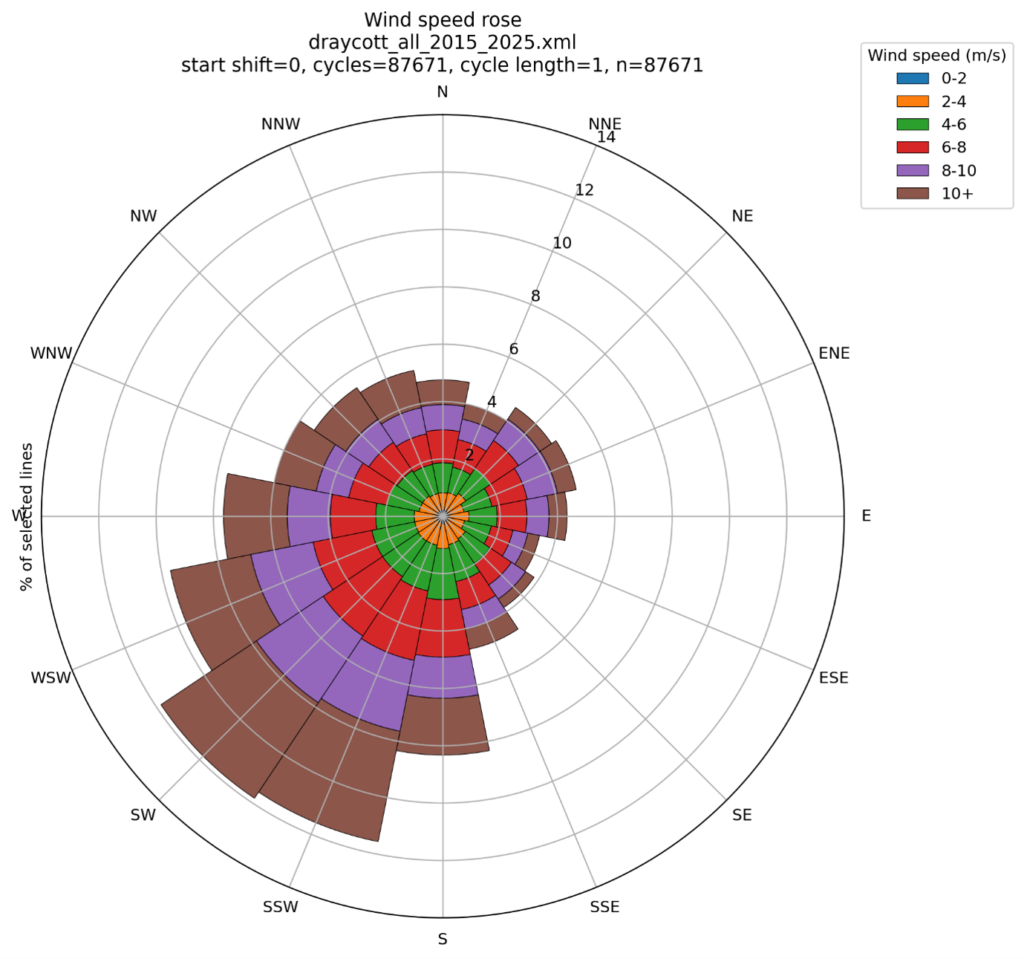
ERA5 met data were collected from the Climate Data Store at https://cds.climate.copernicus.eu/datasets/reanalysis-era5-single-levels?tab=download for a node at (103.75E, 1.25N) for the full period 2015 – 2025 and used to deduce the stability category.  

The resulting wind-speed rose is shown below.
and the wind direction frequency below:
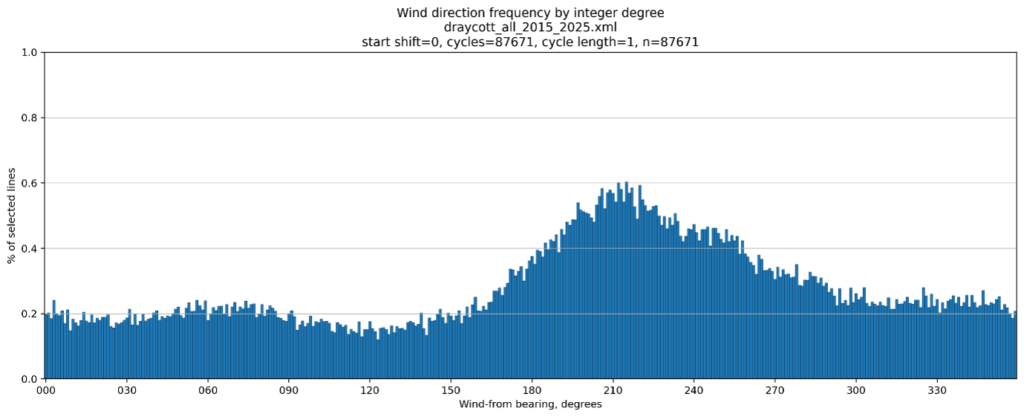
What this presentation fails to show is the outlying sequences, met sequences that might be expected to cause high doses further downwind than usual. These include sequences with very low mixing layers and sequences with very low wind speed (see table)

SequenceMix Layer/ mCatWind speed/ m/sRainfall
180216F0.410
180314E0.190
180417E0.490
260885B0.110
2698457B0.450
2699268B0.50
2700312B0.170
392142B0.40.317
3951129B0.350.05
4090221B0.030

One of these (1802) is for a wind direction of 92 degrees. The figure below shows the dose as a function of downwind distance estimated using the ADEPT R-91 type dispersion code in the PACE model (https://www.ukhsa-protectionservices.org.uk/pace) calculated for all angle with a 92-degree wind direction with sequence 1802 highlighted.
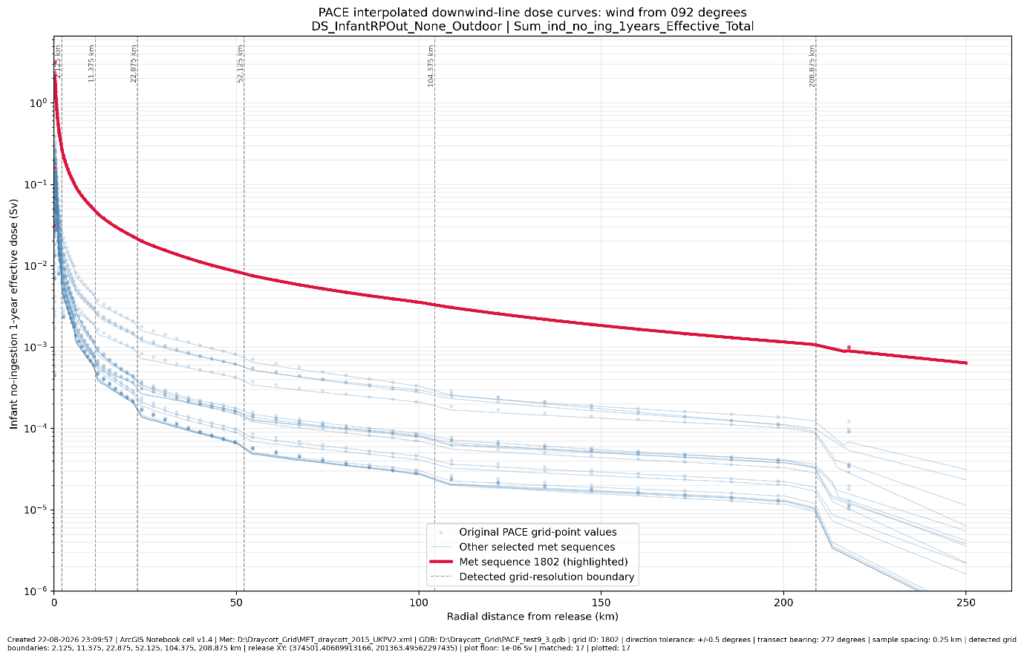
This plot highlights a minor issue with the impact of a change in grid sizes and an issue with the linear interpolation I used to determine the dose at the downwind point of interest (PACE works on a grid rather than your chosen array of points). But it makes the point; there are weather conditions that may produce very different dispersion patterns.

This poses the question “should our emergency planning zones (assuming the source term is accepted as appropriate) be based on the average downwind distance for an exceedance, a high percentile (P95, P98, P100) of the downwind exceedance, or an exceedance by the average dose or a percentile dose at a particular distance”?

UK guidance is to use P95 which should eliminate these outliers (unless your random sample picks up too many of them).

Emergency planners should be aware that an accident could happen on a particularly cold night with very low wind speeds and, if it does, actionable radiation doses might extend much further than expected.

Of course, they might not. With these low wind speeds the penetration of the plume will be very sensitive to deposition (the assumption above is vg=1E-3 m/s) and to changes in the wind speed and direction. Not a good night to depend on your default arrangements or your dispersion code.

Rishi Sunak’s Inside View and the future of nuclear accident protective actions

We are living in a period when the costs of the Covid lockdowns seem to be noticeable if not quantifiable; disrupted education for our children with increased attainment gaps between the rich and the poor, even longer waiting lists in the NHS, a rise in the late detection of cancer, excess deaths from all causes and economic dislocation.

There is an interesting article in the Spectator magazine from a few weeks ago in which Rishi Sunak says that these effects could have been predicted, which seems sensible, and that, if they had been given proper weight, we would have spent less time in lockdown, which is less clear.

We must remember that we feared that Covid would leave many thousands of people struggling to breathe and a lot of them dying an uncomfortable and avoidable death because of lack of medical facilities. We must also remember that there were many voices calling for stricter rules to be applied for longer.

Before we attack the costs of lockdown, we should maybe estimate how many peoples’ lives it saved. I don’t know if that estimate is available. Would the UK deaths from covid (currently standing at 171,048 as of 5/9/22 according to coronavirus.data.gov.uk) have been a few times higher or orders of magnitude higher? The first lockdown on 23rd March 2020 was two weeks before the first peak and rapid decline in cases – coincidence?

covid graph

The lockdown came when the scientists advising the government reported that the Covid deaths could reach 500,000 if no action was taken but could be below 20,000 if Britain locked down. That is quite a range of outcomes. It is not often someone has the chance to save 480,000 lives.

There then came a period of “following the science”. Rishi Sunak states that any attempt to discuss the downside costs were brushed aside and a “fear narrative” launched to increase adherence to shut down.

He also reports that he could not get his hands on an explanation of the assumptions, uncertainties and sensitivities behind the headline numbers and he says that “UK government policy – and the fate of millions – was being decided by half-explained graphs cooked up by outside academics” (it is not clear to me if he was talking about millions of people or millions of pounds).

The real problem, and Rishi Sunak identifies it, is that a lot of weight was put on the scientific educated guesses about the possible fatality tally and maybe not enough thought into considering the full range of costs. Whether or not that would have, or should have, changed the lock-down strategy is unclear.

What does this mean for the nuclear industry? We have arrangements to move people into shelter, evacuate them from their homes and provide them with thyroid blocking drugs in the short term and food controls and, possibly, area controls in the longer term.

We have scientists advising the Strategic Co-ordination Group via STAC or directly (I used to be one when I worked for Magnox). We have another set of scientists advising SAGE, who feed into the national response.

The Strategic Coordinating Group is composed of senior representatives of the emergency services, local government and health bodies. Do they have the ability and confidence to put the estimated doses and avertable doses into context and make clear judgments on the need for protective actions? What should we do with playgroups, schools, hospitals and care homes within the areas potentially affected by a severe nuclear accident? Do we shelter the population for 2 days or 2 weeks or do we drop the shelter advice once the remaining avertable dose is below the lower ERL for shelter? How will the public and media react? Do we have better answers now than we had three years ago?

The nuclear industry should look at the deliberations that went into lockdown and other counter-covid instructions and at the public response to them in the short, medium and long term to see if there are any lessons to learn.

Rishi Sunak has given us his inside story. There are many more to hear and balance.

What is the case for the nuclear emergency planning community’s snobbishness about improvised respiratory protection for the general public?

In my many years as an emergency planner in the nuclear industry I’ve never heard a real debate about respiratory protection as a public protective action in the event of an accidental atmospheric release of radioactivity. It has always been dismissed because without proper masks and fit testing the protection factors offered are compromised.

In 1981 the IAEA [1] identified that respiratory protection was one way to reduce dose uptake in workers and members of the public. It recognised that high levels of protection require properly designed and fitted devices and realised that these would only be available to those with planned roles in a response. They accepted that if any use is to be made of such measures by the public, the simple equipment and techniques to be employed can only be of a very rudimentary nature.

They provided a quite extensive table of filtration factors for common materials. This included the finding that 16 layers of man’s cotton handkerchiefs provides a geometric mean efficiency of 94.2% against aerosols of 1-5 μm particle size – a protection factor not to be sneezed at. At eight layers the efficiency drops to 88.9%. A single bath towel is worth 73.9%.

The public, they said, “can be advised to use such simple items while proceeding to take shelter, and possibly during sheltering. Similar precautions could be recommended while members of the public were being evacuated from a contaminated area”.

In 2002 the US NCR published a document [2] which suggested that improvised respiratory protection can be used as a secondary protective action that can be used to provide a nontrivial level of additional protection. They also provide a table of protection factors.

In 2007 IAEA stated that [3] “Improvised respiratory protection (e.g. a wet cloth over the mouth and nose) has been shown to be effective but it has not been demonstrated that the public will apply it effectively during an emergency. Improvised respiratory protection should not be assumed to provide adequate protection from an inhalation hazard and therefore its implementation should not be allowed to interfere with evacuation or sheltering”. This does not say that improvised respiratory protection should not be recommended under any circumstances; it just says it should not be used instead of shelter or evacuation.

The latest advice on the protection of the public in the event of a nuclear accident from PHE [4] makes no mention at all of RPE, improvised or otherwise. This publication suggests a dose reduction factor of 0.6 for inhalation dose from shelter in place over the period of a release.

So why have we taken improvised respiratory protection out of our tool box of techniques to reduce public dose? It seems to offer protection factors at least comparable with shelter in place for particulate activity.

We worry about golf courses and caravan parks within our DEPZs where shelter in place is considered likely to be ineffective. Could we at least provide a supply of half decent face masks with the stable iodine tablets we store at these establishments as a secondary protection while thinking about evacuation?

Does the Covid-19 experience that shows that large fractions of the population will wear face masks when advised and has made them far more available to the public change our current attitude?


  1. IAEA, Safety Series No. 55, Planning for Off-Site Response to Radiation Accidents in Nuclear Facilities
  2. US NCR, Perspectives on Reactor Safety, NUREG/CR-6042, Rev. 2 SAND 93-0971
  3. IAEA Safety Standards Series No. GS-G-2.1, Arrangements for Preparedness for a Nuclear or Radiological Emergency (2007), https://www-pub.iaea.org/MTCD/Publications/PDF/Pub1265web.pdf
  4. PHE, Public Health Protection in Radiation Emergencies, PHE-CRCE-049, (2019).